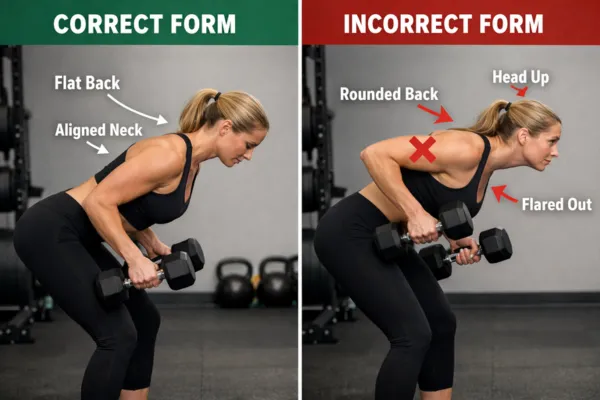
Form Over Ego: Lifting Technique That Builds Muscle (Not Injuries)
You're benching 225 pounds. But your butt comes off the bench, your elbows flare out, you bounce the bar off your chest, and your spotter is basically doing rows. You got the weight up. You count it as a rep. You post the number online. Your ego is satisfied.
Meanwhile, someone else is benching 185 pounds with perfect form—full range of motion, controlled descent, proper bar path, tight setup, no assistance. Who's building more muscle? Who's training more effectively? Who's going to be stronger in six months? And who's headed for a shoulder injury?
Here's the truth most gym-goers don't want to hear: the weight on the bar doesn't matter if your form is terrible. Ego lifting with sloppy technique doesn't build muscle efficiently, increases injury risk dramatically, and creates movement patterns that limit long-term progress.
Perfect form is what actually stimulates muscle growth. Controlled movement through full range of motion with appropriate load creates the mechanical tension that drives hypertrophy. Cheating the weight up with momentum, partial reps, and compensatory patterns might feed your ego, but it's not building muscle.
Let's break down why form matters more than numbers, common form mistakes that sabotage progress and create injuries, how to actually assess your own form, cues for perfect technique on major lifts, and how to build strength with integrity instead of ego.
Why Form Is More Important Than Weight
The hierarchy of training priorities.
Mechanical Tension Requires Control
How muscle growth actually works:
Muscle must be under tension
Through full range of motion
With controlled tempo
The target muscle doing the work
Ego lifting defeats this:
Momentum does the work (not muscle)
Partial range of motion (minimal tension)
Fast, uncontrolled reps (reduced time under tension)
Wrong muscles compensating (target muscle barely working)
Example: Quarter squats with 405 lbs vs. full-depth squats with 225 lbs
Quarter squats: ego satisfied, minimal quad development
Full squats: humbling weight, maximum quad development
Which builds more muscle? The one that actually stresses the muscle.
Injury Prevention Is Long-Term Gain
The math of training longevity:
5 years of perfect form training: continuous progress
5 years of ego lifting: 2 injuries requiring 4 months off each = 8 months not training
Net result: perfect form = more total training time = more total gains
Common ego-lifting injuries:
Rotator cuff tears (from bench press with flared elbows)
Lower back herniation (from rounded deadlifts)
Pec tears (from excessive bench weight or bouncing)
Knee issues (from poor squat mechanics)
Elbow tendonitis (from heavy curls with momentum)
One serious injury can cost you months or years of progress.
Perfect form is investment in injury-free training for decades.
Progressive Overload Requires Consistent Standards
How real strength is built:
Perfect form at X weight
Over time, perfect form at X+10 weight
Continuous progression with same standards
Measurable, meaningful improvement
Ego lifting progression:
Sloppy form at X weight
Over time, sloppier form at X+10 weight
"Progress" that isn't really strength gain
Just getting better at cheating
The question: Are you getting stronger, or just getting better at moving weight poorly?
Real progress: weight increases while form stays perfect.
Common Form Mistakes
What most people get wrong.
Squat Form Errors
Mistake 1: Partial depth
Stopping above parallel
Knees barely bend
"Ego quarter-squats"
Why it's bad:
Minimal quad development
Missing glute/hamstring engagement
Knee strain without muscle development
Not actually squatting
The fix:
Hip crease below knee (at minimum parallel)
Full depth if mobility allows
Reduce weight to hit depth
Build mobility for deeper squats
Mistake 2: Knees caving inward (valgus collapse)
Knees collapse together
Especially at bottom or coming up
Very common error
Why it's bad:
Massive knee injury risk (ACL tears)
Reduced force production
Poor glute activation
The fix:
"Knees out" cue throughout movement
Strengthen glutes and hip external rotators
Reduce weight until control established
Consider stance width adjustment
Mistake 3: Excessive forward lean
Torso too horizontal
Bar path forward of midfoot
"Good morning" squats
Why it's bad:
Lower back overload
Reduced quad engagement
Balance issues
Injury risk
The fix:
Chest up, core braced
Bar over midfoot throughout
Work on ankle mobility
May need different squat variation
Deadlift Form Errors
Mistake 1: Rounded lower back
Lumbar spine flexion under load
Most dangerous common error
Why it's bad:
Disc herniation risk
Spinal injury potential
Inefficient force transfer
Career-ending mistake
The fix:
Neutral spine non-negotiable
Reduce weight until back stays flat
Strengthen core and erectors
Perfect setup every single rep
Mistake 2: Hips shooting up first
Butt rises, chest stays down
Becomes stiff-leg deadlift
Why it's bad:
Turns into back exercise (not full-body)
Lower back overload
Reduced leg drive
The fix:
Think "push the floor away"
Hips and shoulders rise together
Maintain back angle through pull
Film yourself to check
Mistake 3: Bar drifting away from body
Bar swings forward
Not vertical bar path
Why it's bad:
Inefficient leverage
Lower back strain
Reduced weight capability
The fix:
Bar stays against shins/thighs
Drag bar up body
Lats engaged (bar pulled toward you)
Vertical bar path
Bench Press Form Errors
Mistake 1: Flared elbows (90-degree angle)
Elbows perpendicular to torso
"T" shape from above
Why it's bad:
Rotator cuff destruction
Shoulder impingement
Pec tear risk
Reduced force production
The fix:
Elbows 45-70 degrees from torso
"Arrow" shape from above
Protects shoulders
Actually stronger position
Mistake 2: Bouncing bar off chest
Fast drop, hard bounce
Momentum-assisted
Why it's bad:
Sternum/rib injury risk
Reduced chest activation
Cheating the hardest part
No control
The fix:
Controlled descent (2-3 seconds)
Touch chest gently
Brief pause (optional)
Drive with muscle, not bounce
Mistake 3: Butt off bench
Hips lifting during press
Unstable base
Why it's bad:
Loses leg drive
Spinal stress
Less stable
Doesn't count in powerlifting
The fix:
Five points of contact (head, upper back, butt, both feet)
Drive through legs without lifting hips
Tight setup from start
Overhead Press Form Errors
Mistake 1: Excessive back arch (leaning back)
Hyperextension to get weight up
Basically incline press
Why it's bad:
Lower back strain
Not building shoulders
Unstable
Injury risk
The fix:
Vertical torso (slight lean okay)
Core braced tight
Glutes engaged
Bar path straight up
Mistake 2: Not locking out overhead
Partial reps
Never reaching full extension
Why it's bad:
Missing hardest part
Reduced delt development
Not complete range of motion
The fix:
Full lockout (arms straight, shrug at top)
Bar over midfoot at top
Complete the rep
How to Check Your Own Form
Self-assessment strategies.
Film Yourself
The essential tool:
Set phone up to record sets
Multiple angles (front, side)
Review between sets
Compare to form videos
What to look for:
Bar path (should be mostly vertical)
Joint positions (proper angles)
Range of motion (full depth, lockout)
Compensatory movements (arching, twisting)
Do this regularly, not just once.
The "Light Weight" Test
If form breaks down with light weight:
The issue isn't strength
It's motor pattern/mobility
Need to address fundamentals
Protocol:
Use 50% of working weight
Film every rep
Form should be absolutely perfect
If not, you have technical issues to fix
Key Position Checks
For each lift, identify:
Starting position (setup)
Bottom position (squat depth, bench touch, deadlift floor)
Top position (lockout)
Each should have specific standards:
Joints in proper positions
Muscles engaged correctly
Stable and balanced
Replicable every rep
External Feedback
Ask for help:
Experienced training partner
Coach or trainer (worth the investment)
Post form check videos (Reddit, forums)
Compare to instructional videos
Don't assume your form is good because it feels good.
Cues for Perfect Form
Mental reminders that improve technique.
Universal Cues (All Lifts)
"Core tight"
Brace abs as if about to be punched
360-degree tension
Protects spine
"Chest up"
Maintains upper back tightness
Prevents rounding
Better bar path
"Control the eccentric"
Slow, controlled lowering
Don't drop or freefall
Builds more muscle anyway
"Full range of motion"
Every rep same depth/height
No partial reps
Consistent standards
Squat-Specific Cues
"Knees out" - Prevents valgus collapse "Hips back" - Initiates movement properly "Chest to sky" - Maintains upright torso "Drive through heels" - Proper weight distribution
Deadlift-Specific Cues
"Lats tight" - Keeps bar close to body "Push the floor away" - Leg drive emphasis "Chest leads" - Prevents hips shooting up "Stand tall" - Complete the lockout
Bench Press-Specific Cues
"Shoulder blades down and back" - Stable base "Break the bar" - External rotation, tight lats "Drive feet through floor" - Leg drive "Press yourself away from bar" - Different mental model
Building Strength With Integrity
The long-term approach.
Start With Weight You Can Control
Ego check:
If form breaks down, weight is too heavy
Period, no exceptions
Doesn't matter what you "should" be able to lift
The protocol:
Find weight where form is perfect
Progress from there
5-10 lb increases for upper body
10-20 lb increases for lower body
Only when form stays perfect
This is humble, but effective.
Every Rep Same Standard
Consistency is key:
First rep = tenth rep (form-wise)
First set = last set (depth/technique)
Heavy day = light day (movement pattern)
When form degrades:
Stop the set
Reduce weight next set
Don't grind through terrible reps
Quality over quantity always.
Film Regular Form Checks
Monthly minimum:
Film working sets
Review honestly
Identify issues
Correct before they become ingrained
Form degrades slowly:
Small errors compound
Become habitual
Regular checks catch this
Prioritize Movement Quality
The hierarchy:
Perfect form
Full range of motion
Controlled tempo
Progressive weight (only when 1-3 are met)
Not:
Maximum weight
Who cares about anything else
Hydration Supports Form
How dehydration affects technique:
Reduced focus and concentration
Impaired coordination
Fatigue earlier (form breaks down)
Muscle cramps (disrupts movement)
Well-hydrated with Grip Hydra:
Better mental clarity for form cues
Sustained performance (maintain technique)
No cramping disrupting sets
Muscle arm reminder: form and hydration both matter
When to Sacrifice Form (Almost Never)
The rare exceptions.
Competition Attempts
Powerlifting meets:
Attempting max single
Some form breakdown acceptable
Still within safe parameters
Judges determine what's legal
This is <1% of your training.
Testing True Max (Rarely)
1RM testing (every 3-6 months):
Form will slightly degrade
Still must be safe
Not training, just testing
Inform your programming
Not for building muscle or training.
Everything Else: Perfect Form Required
All training reps:
95% of what you do
Form must be perfect
This is what builds strength and muscle
Non-negotiable
The Bottom Line: Ego vs. Results
The choice:
Impress people in gym for 5 minutes with heavy weight and bad form
Or build real strength, muscle, and longevity with perfect form and appropriate weight
The long-term reality:
Ego lifters plateau fast, get injured, quit
Form-focused lifters progress consistently for decades
Slow and steady wins
Perfect form is:
Harder (requires discipline)
More effective (better stimulus)
Safer (prevents injuries)
Sustainable (train for life)
Ego lifting is:
Easier (requires no discipline)
Less effective (momentum, partial ROM)
Dangerous (high injury risk)
Unsustainable (injuries force stopping)
Choose wisely.
Your Form-Focused Action Plan
Starting this week:
Film your next 3 workouts (all major lifts)
Review honestly (what needs improvement?)
Reduce weight 10-20% on lifts with form issues
Focus on perfect reps (quality over weight)
Learn proper cues for each lift
Stay hydrated with Grip Hydra (supports focus and performance)
Track real progress (weight with perfect form)
Within 4-8 weeks of form-focused training:
Better mind-muscle connection
Reduced injury risk
More muscle growth (better stimulus)
Real strength gains (not just better cheating)
Sustainable progress
Check your ego at the door. Build real strength with perfect form.

